
Everest Gokyo Lake Trek / Gokyo Ri Trekking
Overview
Everest Gokyo Lake Trek / Gokyo Ri Trekking
The Highlight of Everest Gokyo Lake Trek / Gokyo Ri Trekking
Everest Gokyo Lake Trek: This famous trek offers an opportunity to observe some of the tallest peaks, including Cho Oyu (8188 m / 26864 ft), Gyachung Kang (7952 m / 26000 ft), Everest (8848 m / 29028 ft), and Lhotse (8516 m / 27940 ft).
The trek provides views of the largest Sherpa village and monasteries, where you can explore Sherpa culture, traditions, rituals, and beliefs.
The trip is budget-friendly with an all-inclusive package that includes three meals each day.
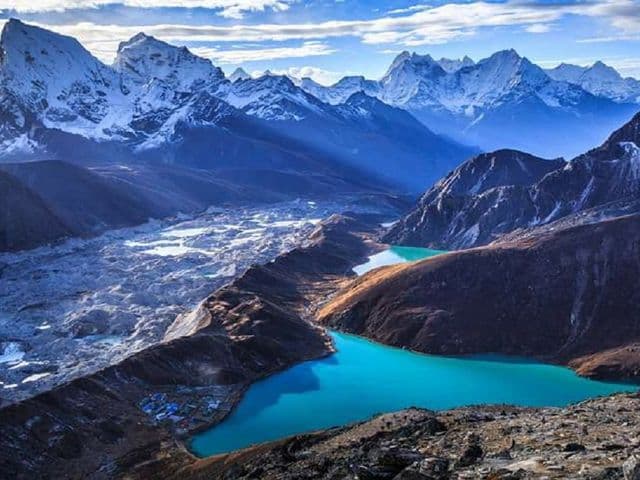
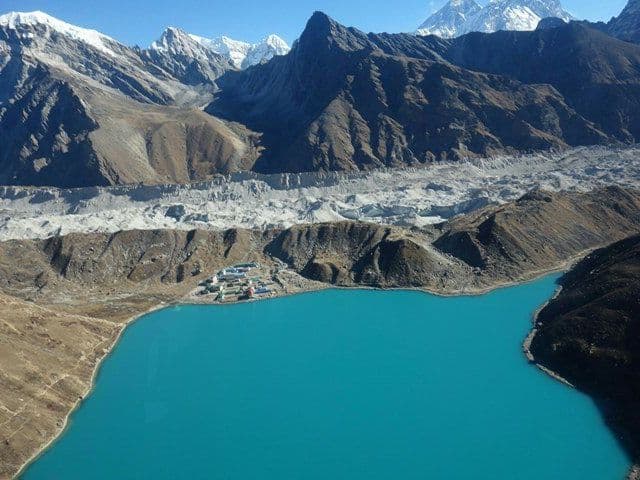
The main attractions of the trek are the enchanting Gokyo Lake, Gokyo Ri, the world’s largest glacier, Ngozumpa Glacier, and the Khumbu Icefall. The trek to Gokyo offers unforgettable moments.
The trek and climb to Gokyo Ri provide stunning sunrise and sunset views of the Himalayas.
Experience the magnificent views of the oligotrophic freshwater lakes, including the First Lake, Second Lake, Gokyo Lake, Fourth Lake, Fifth Lake, and more glacier lakes.
The Everest Gokyo Lake trek leads to the tranquil Gokyo Valley.
Climbing to Gokyo Ri offers the best viewpoint in the Khumbu region for Mount Everest, Mount Makalu, Mount Cho Oyu, and surrounding Himalayan ranges and peaks.
Trip Summary
The Everest Gokyo Lake Trek / Gokyo Ri Trekking is a fascinating journey situated at 5350 m above sea level. It’s an attractive trek passing through Gokyo Ri and Gokyo Lake on the way to Everest Base Camp. During the Gokyo Lake Trek, you will enjoy the true scenery of Nepal, including the tallest mountains, such as Cho Oyu, Gyachung Kang, Everest (8848 m), and Lhotse.
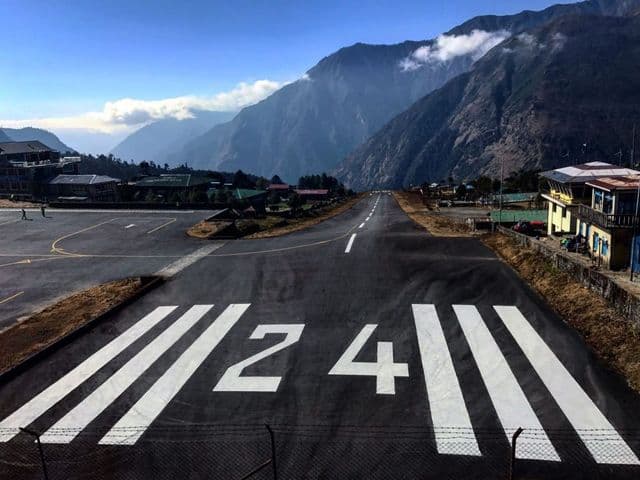
One of the most breathtaking moments is the close-up view of the Himalayas. First, fly to Lukla and trek through hills and valleys, visiting monasteries and Sherpa villages. Lukla is the trekking point of the Everest region. Enjoy the stunningly beautiful views of Gokyo Lakes. Learning about local lifestyle and culture is a major attraction of the Gokyo Chola Pass trek. From Gokyo Ri, you will get better views of Everest and the surrounding Himalayas, and the fascinating glaciers are another famous place to explore. The Everest Gokyo Lake Trek / Gokyo Ri Trekking provides a great view of Gokyo Lake and Everest.
When is the best time to do EBC trekking?
Nepal, as a tourist destination, is good for all seasons; however, the best seasons for trekking to the Everest region are spring (March–May) and autumn (mid-Sept.–mid-Dec.). Trekking in the autumn season is noted for clear weather and excellent views of silvery mountains against blue sky. It gets colder towards the end of December. This trek can be done in any month; even January and February are cooler.
However, it is also a challenging and adventurous trail to Everest Base Camp, with the option to conquer high passes. If you have more days, you can extend your trek to Everest Base Camp with the Gokyo Chola Pass. The Gokyo Lake trek is similar in height to the Everest Base Camp Trek but includes glaciers and lakes along the trail.
Climbing to Gokyo Ri offers stunning 360-degree views, including a grand view of Mount Everest, Mount Makalu, Cho Oyu, and deep clear blue lakes. Gokyo Lake is a holy lake for both Hindu and Buddhist traditions. This trek is an excellent choice to experience the Himalayas, lakes, glaciers, and Sherpa culture.
Visiting the largest Sherpa village, Khumjung, and seeing the Hillary School are other attractions during the Everest Gokyo Lake Trek / Gokyo Ri Trekking. After exploring the village and monasteries, return to Namche for an overnight stay, then back to Lukla to fly to Kathmandu. The Gokyo Lake trekking is one of the best treks in Nepal for exploring magnificent glaciers.
Interested in Gokyo Lake, Gokyo Ri, and Everest Base Camp all at once? Click here.
What‘s Included
What‘s Excluded
Availability
Select your preferred departure date. Trip duration: 14 days
| Su | Mo | Tu | We | Th | Fr | Sa |
|---|---|---|---|---|---|---|
| Su | Mo | Tu | We | Th | Fr | Sa |
|---|---|---|---|---|---|---|
Number of Travellers
Select a date to book
Dates are subject to availability. Please contact us to confirm your preferred dates.
Itinerary
Welcome to Kathmandu, our Sunrise Adventure Trek airport representative will welcome you in the airport and then transfer you to your hotel. At evening we will give you short briefing and further details of the trip program. Overnight stay in hotel
After breakfast visit World Heritage Sites in the Kathmandu Valley which includes Swayambhunath Stupa / Monkey Temple, Bauddhanath Stupa and Pashupatinath Temple. Overnight stay in Hotel breakfast included
We take a flight from Kathmandu to Lukla for about 40 minutes. The scenic flight over the beautiful mountainous city offers the amazing views of stunning mountains. Arriving at Lukla, we meet Sherpas’s here and porters before heading off towards Phakding. The porters’ loads are organized here, in Lukla. Now, trekking towards Phakding our journey passes through amazing alpine forests and settlements of Sherpa people. Walking downhill with the bank of Dudh Khoshi River, takes us to a large stream called Kusum Drargka. Then crossing the stream first, we pass the river Dudh Khoshi and finally reach Phakding. Meals included: Breakfast, lunch and dinner and finally an overnight stay in trekking lodge.
Namche Bazaar is the main administrative and trading centre for the Khumbu region. So, here you can see the people engaged in different occupations for their living. After crossing the bridge we enter into the Sagarmatha National Park in Monjo village. Here we get a chance to explore many species of endangered animals. Along with magnificent forests of blue pine, fir, juniper and rhododendron trek to Namche offers the first view of Everest; it helps you to control the anticipation of the thrilling journey. Namche is the heartland and main touristic hub of Khumbu region. Meals included: Breakfast, lunch and dinner and finally an overnight stay in trekking lodge.
To adopt with the altitude and new surrounding we acclimatize in Namche Bazaar. We spend the day by enjoying the scenes of mountains and sunrise and sunset in Khumbu Peak. We can hike up to Khumjung village where we get to explore the Sherpa Museum. In Sherpa Museum, we can get a chance to observe the Sherpa culture along with history. You can observe all the old Sherpa art facts in this museum. During hiking up the trail, we observe monasteries and the beautiful Hat Bazzar as well. Meals included: Breakfast, lunch and dinner and finally an overnight stay in trekking lodge.
Phortse, one of the valleys in Khumbu region is a farming land with large settlement of Sherpa people. Here we get a chance to explore the daily living style of Sherpa people with their traditional norms and values. Passing through the path full of rhododendrons and Yak kharkas, we begin to gain altitude and pass through the coniferous forest along with juniper trees before we reach to Phortse Thangs. You can find majority of people working as guide from Phortse. We walk up the stone stairs, exploring marvelous views of mountains. Meals included: Breakfast, lunch and dinner and finally an overnight stay in trekking lodge.
This 5 hour trek leads uphill to Cho Oyo, from here we can see beautiful Kengtega valley. After that descend to river and climb steep to the moraine of Ngozumpa glacier. Walking along the riverside we pass beautiful rhododendron forests, streams, waterfalls and wild habitats and reach Tongba village. To reach Maccherma, we pass the same Dole, Labarma and Luzza village. Trek to Maccherma offers the dramatical landscapes views. Crossing the green pastures, we get to observe the stunning views of mountains like Kyojo Ri and Macchermo. Walking along the riverside we pass beautiful rhododendron forests, streams, waterfalls and wild habitats. Meals included: Breakfast, lunch and dinner and finally an overnight stay in trekking lodge.
Following the lama foothprints, we trek to Gokyo which is surrounded by Mountains. We cross the second lake Longponga (4690m) and arrive to Gokyo after crossing a boulder-strewn path at the edge of third lake. Trail to Gokyo Lake is not so much hard climbing a ridge we get an excellent views of mountains like Cho-Oyu, Kantega, Cholatse and Panga . Before climbing up to the glacier, Ngozumpa we descend down to the bank of river. Now steeply climb up to the moraine takes us to the lower lake at 4650m and upper lake at 4690m. Thus, passing these lakes taking 4 to 5 hours, we reach at Gokyo Lake 4790m. Meals included: Breakfast, lunch and dinner and finally an overnight stay in trekking lodge.
Now we climb up to the narrow and little difficult path to reach Gokyo Ri at an elevation of 5483m.This place truly is rewarding as we can get super great view of Gokyo Valley and Khumbu Himalays such as Everest, Lhotse, Nuptse, Makalu, Cho-Oyu, Makalu, Tabuche, Tawachee, Gychung Kang and many more. Now having the dramatical views of these excellent 7 highest peaks, we get back down to the fascinating Gokyo Lake. Following the same trail, through amazing lush green forests filled with rhododendron flowers, we also observe the wild habitats of Himalayan region. Reaching at Gokyo, we rest our beautiful moments at the edge of the lake. Meals included: Breakfast, lunch and dinner and finally an overnight stay in trekking lodge.
We return through the same route of Rhoodendrons and Yak kharkas to give continuity to our trip. We pass the Gokyo Lake with the spectacular views of mountains Cholatse, Taboche, Cho-Oyu, Thamserku and many others. We slowly cross the small river streams after reaching at a stupa. Passing through the tiny villages of Gyele, Macchermo, Luza, Labarma and Tongba we finally arrive at our today’s destination; Dole. Meals included: Breakfast, lunch and dinner and finally an overnight stay in trekking lodge.
Today we trek to Namche Bazzar, pass the Phortse Tenga. And again from Phortse Tenga to Mong La Danda. During the trail we get the excellent views of mountains like Thamserku, Ama Dablam, Taboche and Kangtega. The trail from downward the hills offer us the best views of Khumbila Peak as well. Khumbila peak is also refers as the “God of Khumbu”. Following the route of Khumjung village we get a chance to closely observe the daily living style of Sherpa people with their unique traditional norms and values. Again we get to refresh our memory and once again visualize the scenery once we had left behind and reach Namche Bazzar. Meals included: Breakfast, lunch and dinner and finally an overnight stay in trekking lodge.
This will be our last trek and today we will be trekking to Lukla to catch our flight to Kathmandu. We trek back the rocky trail, passing the tiny Sherpa settlements and suspension bridges. We will spend the day by sightseeing around Lukla with marvelous views of Lhotse and Nuptse. Meals included: Breakfast, lunch and dinner and finally an overnight stay in trekking lodge.
In the morning we take flight back to Kathmandu and once again enjoy the scenic valleys and terrains full of beautiful mountains view and locations.
You can visit around Kathmandu and take a day off to enjoy the historic city or do some shopping. Join Sunrise Adventure Treks; provide you an evening meal with cultural program.
A representative from Sunrise Adventure Treks takes you to the airport before 3 hours of your departing time. Or you can join another trip with Sunrise Adventure Treks and Tour.
FAQs about
the trip
Nepal, as a tourist destination is good for all seasons, however, the best seasons for trekking to Everest region are Spring (March-May) and Autumn (mid-Sept. – mid-Dec.). Trekking in autumn season is noted for clear weather and excellent views of silvery mountains against a blue sky. It gets colder towards the end of December. This trek can be done in any month except January and February. G
Nepal, as a tourist destination is good for all seasons, however, the best seasons for trekking to Everest region are Spring (March-May) and Autumn (mid-Sept. – mid-Dec.). Trekking in autumn season is noted for clear weather and excellent views of silvery mountains against a blue sky. It gets colder towards the end of December. This trek can be done in any month except January and February. G
Nepal, as a tourist destination is good for all seasons, however, the best seasons for trekking to Everest region are Spring (March-May) and Autumn (mid-Sept. – mid-Dec.). Trekking in autumn season is noted for clear weather and excellent views of silvery mountains against a blue sky. It gets colder towards the end of December. This trek can be done in any month except January and February. G
Nepal, as a tourist destination is good for all seasons, however, the best seasons for trekking to Everest region are Spring (March-May) and Autumn (mid-Sept. – mid-Dec.). Trekking in autumn season is noted for clear weather and excellent views of silvery mountains against a blue sky. It gets colder towards the end of December. This trek can be done in any month except January and February. G
Nepal, as a tourist destination is good for all seasons, however, the best seasons for trekking to Everest region are Spring (March-May) and Autumn (mid-Sept. – mid-Dec.). Trekking in autumn season is noted for clear weather and excellent views of silvery mountains against a blue sky. It gets colder towards the end of December. This trek can be done in any month except January and February. G
Nepal, as a tourist destination is good for all seasons, however, the best seasons for trekking to Everest region are Spring (March-May) and Autumn (mid-Sept. – mid-Dec.). Trekking in autumn season is noted for clear weather and excellent views of silvery mountains against a blue sky. It gets colder towards the end of December. This trek can be done in any month except January and February. G
Nepal, as a tourist destination is good for all seasons, however, the best seasons for trekking to Everest region are Spring (March-May) and Autumn (mid-Sept. – mid-Dec.). Trekking in autumn season is noted for clear weather and excellent views of silvery mountains against a blue sky. It gets colder towards the end of December. This trek can be done in any month except January and February. G
Nepal, as a tourist destination is good for all seasons, however, the best seasons for trekking to Everest region are Spring (March-May) and Autumn (mid-Sept. – mid-Dec.). Trekking in autumn season is noted for clear weather and excellent views of silvery mountains against a blue sky. It gets colder towards the end of December. This trek can be done in any month except January and February. G
Nepal, as a tourist destination is good for all seasons, however, the best seasons for trekking to Everest region are Spring (March-May) and Autumn (mid-Sept. – mid-Dec.). Trekking in autumn season is noted for clear weather and excellent views of silvery mountains against a blue sky. It gets colder towards the end of December. This trek can be done in any month except January and February. G
Nepal, as a tourist destination is good for all seasons, however, the best seasons for trekking to Everest region are Spring (March-May) and Autumn (mid-Sept. – mid-Dec.). Trekking in autumn season is noted for clear weather and excellent views of silvery mountains against a blue sky. It gets colder towards the end of December. This trek can be done in any month except January and February. G
Nepal, as a tourist destination is good for all seasons, however, the best seasons for trekking to Everest region are Spring (March-May) and Autumn (mid-Sept. – mid-Dec.). Trekking in autumn season is noted for clear weather and excellent views of silvery mountains against a blue sky. It gets colder towards the end of December. This trek can be done in any month except January and February. G
Speak to an Expert
Suresh Bhandari
Leave a Reply
Your email address will not be published.